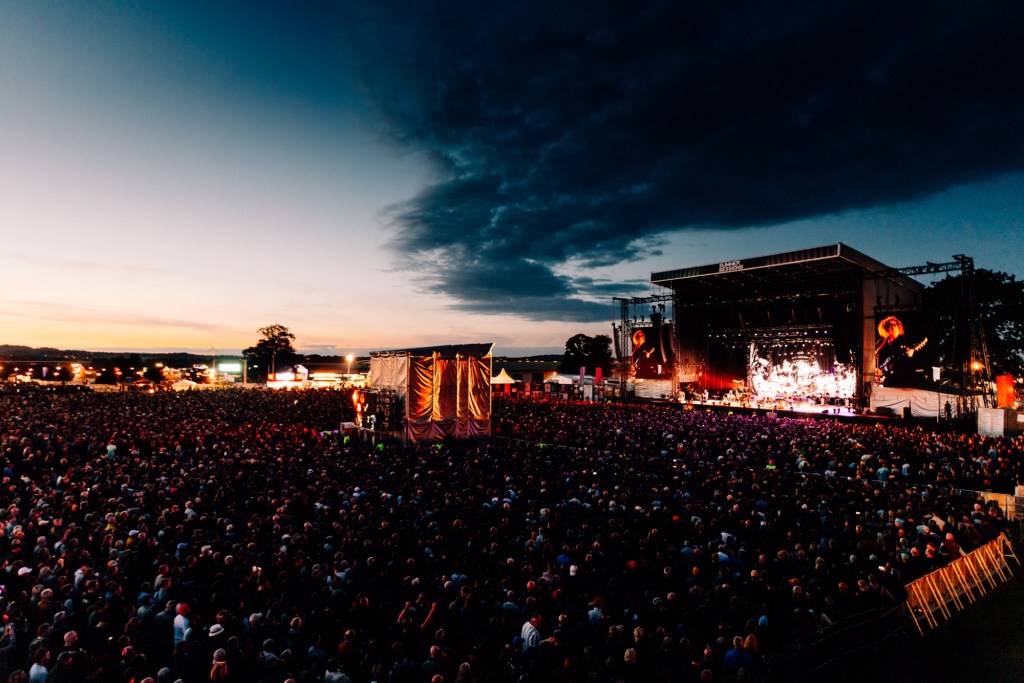
There are certain bands you go to see because you like them, and then there are bands who have been living rent-free inside your emotional nervous system for decades. The Cure are firmly in the latter category. My 20’s were soundtracked shuffling across the hallowed grounds of the ABC dance floor with hair back combed within an inch of its life et al Robert Smith himself as the synthe overture of “Just Like Heaven” played in the background. Seeing them live is like being invited into a beautifully decorated mausoleum where everyone has agreed that heartbreak is actually quite fun if you put the right bassline underneath it…
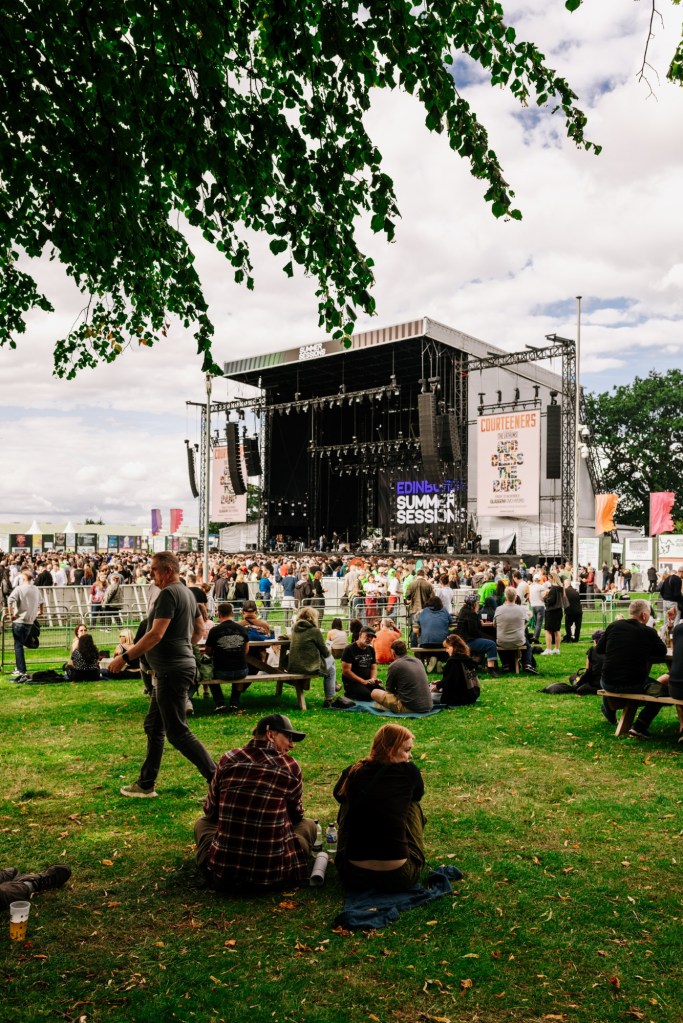
Last night at Edinburgh’s Royal Highland Showground, the bill was an unusually good exercise in alternative darkness. Just Mustard opened proceedings, followed by Slowdive and then, in a particularly welcome surprise, Glasgow’s finest, Mogwai. It was an evening that seemed to have been curated by someone with a very specific understanding of the human capacity for melancholy.
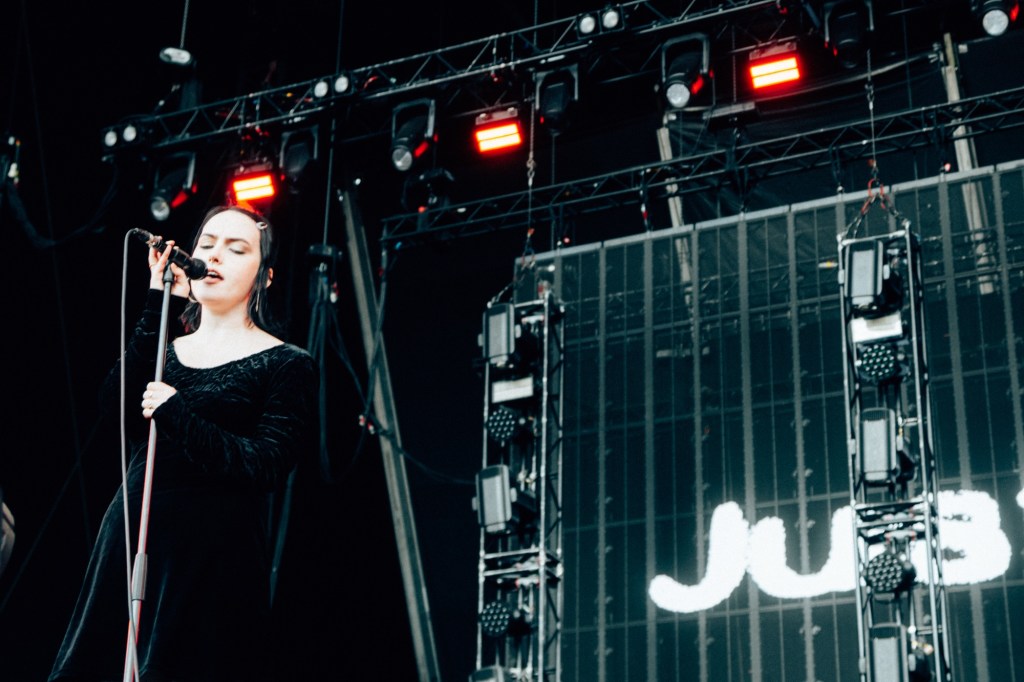
I’ve been low-key obsessing over Just Mustard since 2018’s Wednesday, and seeing them here felt like watching a band who have spent the last few years turning post-punk into something stranger, heavier and considerably more nocturnal. The Dundalk five-piece sound like the aftermath of a bad dream in an abandoned factory: industrial textures, bruised guitars and Katie Ball’s voice drifting through it all like a radio transmission from another dimension. “Death” remains my ultimate favourite, but “We Were Just Here”, from their more recent work, shows how much their sound has expanded without losing that deliciously bleak centre. There is a post-punk blues running through Just Mustard that feels particularly potent in the current Irish scene. Everything coming out of Ireland at the moment seems to have a little more darkness in its bloodstream, and Just Mustard are among the most compelling examples.
Next came Slowdive. Not quite our thing, perhaps, but unquestionably a band worth seeing live. Their shoegaze is less a performance than an atmospheric event: layers of guitar rolling over the crowd until individual songs become almost indistinguishable from weather. “When the Sun Hits” would have been the obvious emotional landmark, that glorious collision of beauty and distortion, and they did exactly what Slowdive do best — create music that feels as though it is simultaneously arriving and disappearing.

Then came the surprise: Mogwai.
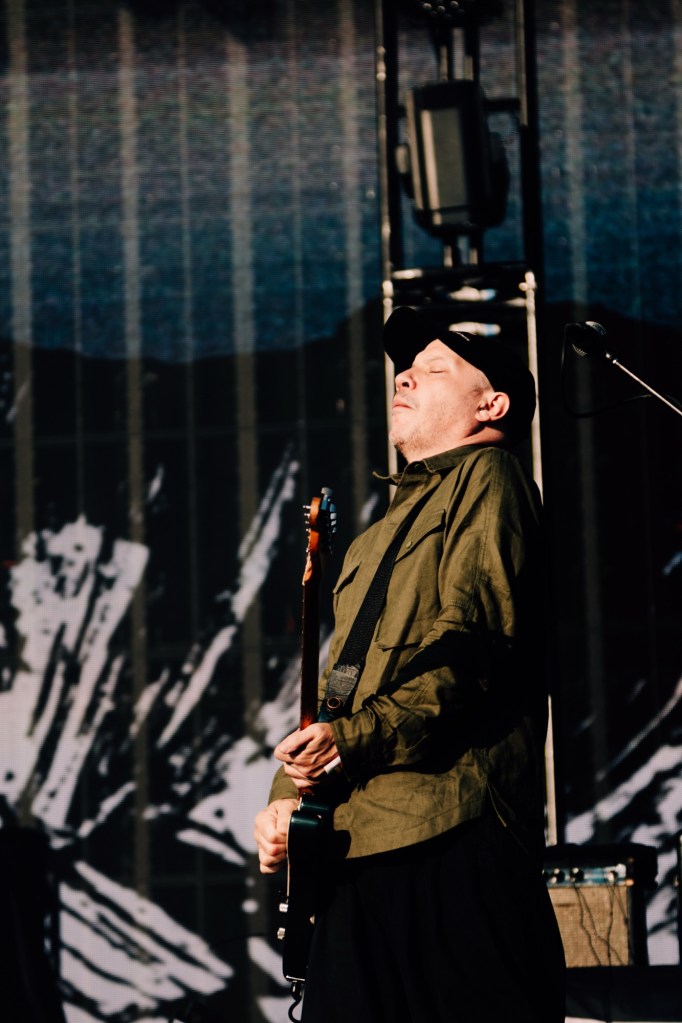
Somehow I had managed not to know Glasgow’s finest were playing, which is the kind of pleasant error one would like to make more often. For a band whose music contains no conventional lyrical narrative, they drew a sizeable crowd and proved an almost perfect precursor to The Cure. Mogwai have always understood the dramatic power of volume and repetition: they take a simple musical idea, feed it steroids and send it charging towards the horizon. “God Gets You Back”, from The Bad Fire, was a particularly fitting reminder of their ability to turn instrumental music into something enormous and emotionally cinematic.
And then there was The Cure.
My fellow photographer friend summed it up perfectly: The Cure make music for people who are moody.
They do. But they also make music for people who have discovered that being moody is much more enjoyable when several thousand other people are doing it with you.
The venue was sold out, and Robert Smith and his fellow middle-aged goths proceeded to deliver one of the best Cure shows I’ve seen in a long time. I had reservations after seeing them at Bellahouston Park seven years ago. That show had suffered, for me, from problems of pacing and timing, with a noticeable slump developing through the middle. Last night there was none of that. The set had shape, momentum and atmosphere. It knew when to brood and when to let the roof come off.
“Pictures of You”, appearing second, was an immediate statement of intent. Taken from 1989’s Disintegration, it is one of The Cure’s great songs of memory: seven minutes of looking backwards while pretending you’re not. The guitars shimmered and the song seemed to stretch across the Showground like an old photograph left out in the rain. This is what The Cure do better than almost anyone: they turn nostalgia into a physical substance.
“High”, from 1992’s Wish, followed, and suddenly the gloom had a pulse. It is one of those Cure songs that manages to be melancholic and euphoric at exactly the same time. Their music has always understood that happiness and sadness are not opposite ends of a scale; sometimes they are sitting in the same room, drinking from the same bottle.
Then came “Lovesong”, and this is where the whole goth enterprise starts to reveal its rather embarrassing secret.
It is incredibly romantic.
Written by Robert Smith for Mary Poole, his long-time girlfriend and future wife, “Lovesong” is perhaps the most straightforwardly sincere thing The Cure ever committed to tape. It comes from Disintegration, an album otherwise overflowing with emotional catastrophe, yet here Smith strips everything back and simply says: I love you.
There is something almost revolutionary about that level of sincerity.
We like to think of goth as music about death, but at its heart it is music about wanting something so badly that the possibility of losing it becomes unbearable. The black clothes are merely camouflage for an enormous sentimental heart.
And nowhere is that more obvious than “Just Like Heaven”, which appeared at number 11 in the set.
Written for the same woman who was then Smith’s high-school sweetheart, the song was inspired in part by a trip to the coast and the physical delirium of kissing her so intensely that he felt as though he might pass out. Robert Smith, it turns out, did not write the song because he was haunted by the void.
He wrote it because he was winching his girlfriend.
If that isn’t romance, I don’t know what is.
The song comes from 1987’s Kiss Me, Kiss Me, Kiss Me, an album that remains one of The Cure’s great acts of stylistic indecency: pop, goth, psychedelia, funk, new wave and pure romantic absurdity all thrown together and somehow making perfect sense. Live, “Just Like Heaven” remains almost unbearably joyous. Everyone knows it. Everyone sings it. For three minutes, several thousand people who presumably spend most of their lives pretending not to care about anything are openly screaming about love.
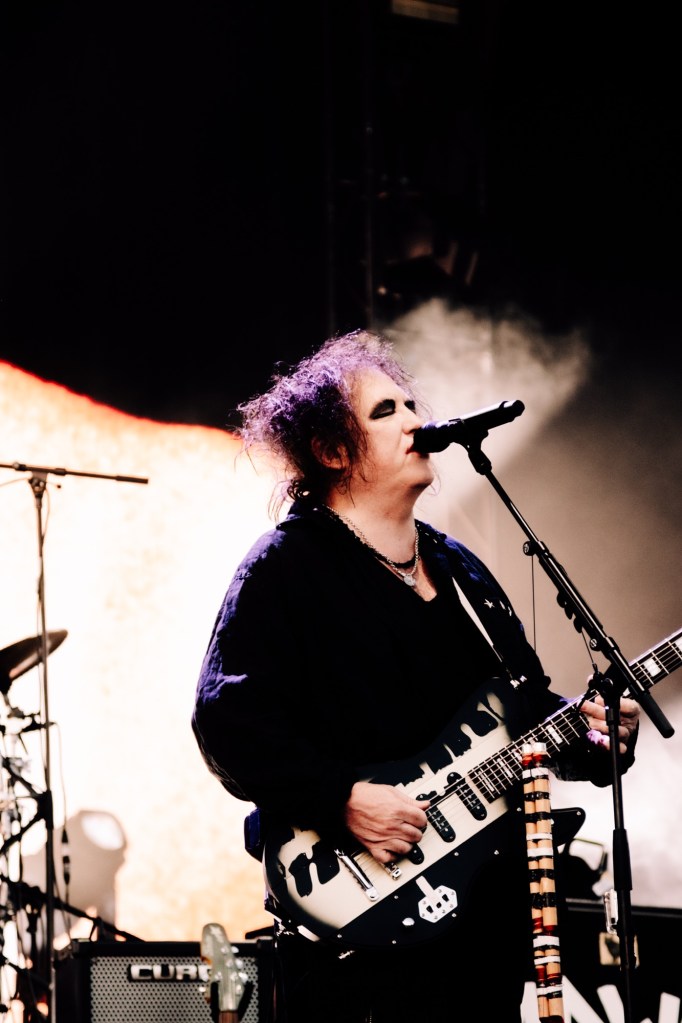
Another stand out track; “Three Imaginary Boys”, taking us all the way back to the band’s 1979 debut. It was remarkable hearing such an early Cure song inside a set that also contained the huge, mature melancholy of Disintegration. The contrast showed just how far they have travelled.
“A Night Like This”, from 1985’s The Head on the Door, arrived its saxophone adding another shade to that wonderfully nocturnal Cure palette. With Gabriel Cooper on sax, it had the atmosphere of a smoky bar at 2am, when everyone has either fallen in love, had their heart broken or is about to make an appalling decision.
Then came “A Forest” it was one of the evening’s defining moments.
If you want to understand The Cure, “A Forest” is the instruction manual. It comes from 1980’s Seventeen Seconds, and its bassline seems to walk permanently towards something it knows it will never find. The guitars circle, the drums stalk, and Smith’s voice sits somewhere between detachment and desperation. It is music about searching without any expectation of finding the thing you are looking for.
The genius is that it makes the search sound magnificent.
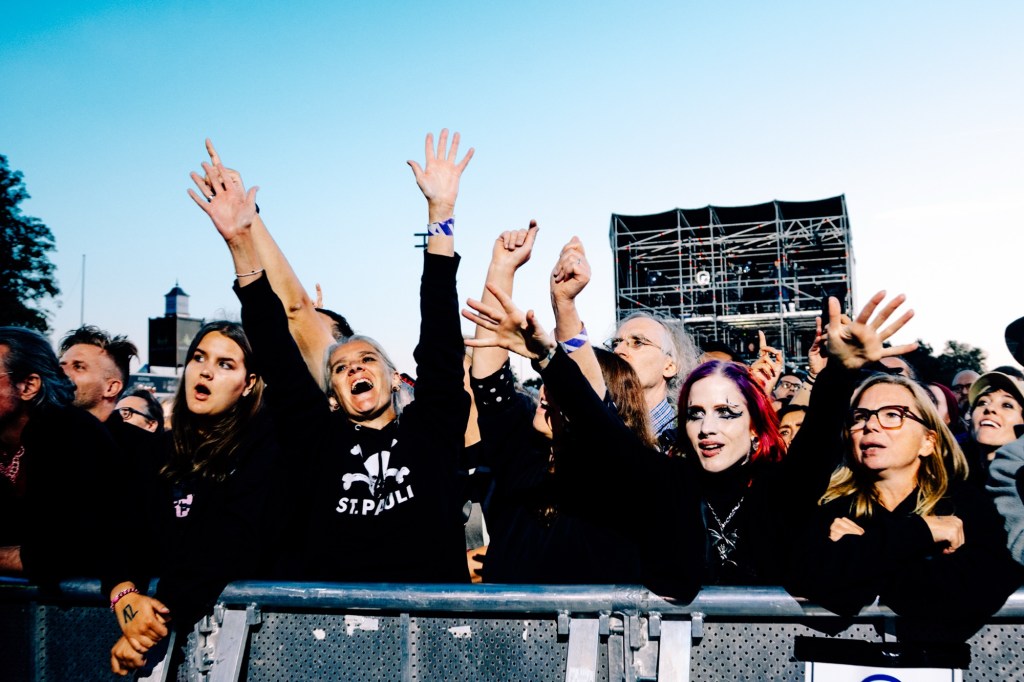
The title track of Disintegration arrived, and the show briefly became less a concert than an emotional landslide. The song is eight minutes of beautifully controlled collapse. It is The Cure at their most excessive and their most honest, a song that doesn’t merely describe falling apart but seems determined to demonstrate the process in real time.
And then, eventually, the hits were saved for the encore.
“Lullaby”, from Disintegration, opened that final stretch with one of The Cure’s strangest triumphs: a song about nightmares that somehow became a pop classic. It is sinister, sexy, funny and deeply weird, which is essentially the Cure manifesto in four words.
“The Lovecats” then arrived, the gloriously unhinged 1983 single from the Japanese Whispers period. It sounds like The Cure briefly escaped from their own funeral, wandered into a jazz club and decided to have a bit of a laugh. The fact that it works so well after nearly two hours of gothic drama is another reminder that The Cure have never been interested in being miserable in a straightforward way.
“Let’s Go to Bed” followed, one of the great moments of Cure self-sabotage. After the monumental bleakness of Pornography, Smith and company essentially responded by making a bizarrely seductive synth-pop song. It was a refusal to remain trapped inside their own gloom. The Cure have always known when to pull the curtains back and let a little sunlight into the crypt.
Then came “Friday I’m in Love”.
If there was any remaining doubt that this was a show built as much on pure enjoyment as nostalgia, it evaporated here. From 1992’s Wish, it remains one of the great happy songs by a band who have spent most of their career making sadness sound glamorous. The entire place seemed to briefly forget that it was supposed to be a gathering of people dressed almost exclusively in black.
Finally came “Why Can’t I Be You?”, from Kiss Me, Kiss Me, Kiss Me, and it was the perfect closing statement: ridiculous, exuberant, romantic and completely without shame.
The Cure have always understood that darkness needs light. Without it, there is no contrast, no drama and ultimately no fun. They can spend eight minutes disintegrating emotionally and then follow it with a song about Friday, dancing, kissing or going to bed. That is why they have survived where so many of their contemporaries have become museum pieces.
This was a show studded with gems throughout, but it was also pure nostalgia. Not the dead-eyed nostalgia of a heritage act going through the motions, but the intoxicating kind: the nostalgia of hearing songs that have accompanied entire sections of your life and discovering that they still work.
That is The Cure’s particular magic.
They make private misery communal. They take heartbreak, lust, regret, longing, ageing and romantic obsession and turn them into something you can sing at the top of your lungs with thousands of other people. They make the humiliations of being human feel grand.
Robert Smith looked, as ever, like a man who had been dragged reluctantly from a Victorian séance to headline a rock concert. But the band sounded anything but old. The music still had teeth. It still had romance. It still had that peculiar ability to make sadness feel like a place worth visiting.
Because perhaps that is what goth really is.
Not death.
Love.
Painfully, embarrassingly, magnificently romantic love.
We are all goths at heart.
And last night, in Edinburgh, The Cure reminded us why.
Words: Angela Canava
Images: Ryan Buchanan

