
It took a certain amount of nerve, aged 15, to walk into my sixth-year common room with a fresh copy of that week’s NME tucked under my arm, pink-and-green colour-panelled hair framing a face that had not yet learned the consequences of having opinions, and announce to the popular boys: “You know, Linkin Park are okay, but we should really listen to Deftones.”
This was not a casual recommendation. This was diplomacy. This was foreign policy. This was me, in hair that borrowed directly from The Raveonnetts, attempting to influence the cultural direction of an entire school.
A few days later, one of the popular boys — eyebrow piercing, Eminem wardrobe, the full early-2000s uniform of adolescent menace — swaggered into the common room and announced that he had listened to Deftones.
“You were right,” he said. “They’re cool.”
And that was it. My teenage street cred, previously hovering somewhere around “girl with alarming hair”, had been catapulted into the stratosphere.
I have never quite recovered from the power.
Because Deftones were the band for that particular teenage feeling: the horrible, thrilling, chemically unbalanced cocktail of lust, rage, insecurity and the absolute certainty that nobody — NOBODY — could possibly understand what you were going through. Their music sounded like somebody had taken teenage angst, put it in a blender with sex and existential dread, then poured the result over a giant Marshall stack.
Deftones were never simply heavy. They were heavy in the way a teenage crush is heavy. Heavy in the way waiting for somebody to text back is heavy. Heavy in the way standing outside the gym hall hoping a particular person might appear is heavy.
They were music for wanting to kiss somebody and punch a wall at exactly the same time.
I first encountered them in that great late-‘90s/early-2000s alternative-music ecosystem when Zane Lowe ruled supreme from the brown couch on MTV2’s Gonzo. This was before streaming had turned discovering music into an algorithmic vending machine. Back then, you watched Gonzo because there was a genuine possibility that Zane might put something terrifying, brilliant or completely life-changing in front of you.
Deftones fitted that world perfectly. They could appear alongside a band like The Rapture and somehow make perfect sense. The Rapture had the angular, sweaty, art-school disco; Deftones had the black hole. One made you want to dance in an East London warehouse, the other made you want to stare moodily out of a bedroom window while pretending your life had already become a tragedy.
It was the golden age of MTV2, when music television still felt like a secret society and Zane Lowe was its hyperactive high priest.
Fast-forward several decades and I am standing at Summer Sessions in Edinburgh, looking around at an audience largely composed of people in their late 30s, 40s and 50s.
The great joke is that we have all grown up.
The music hasn’t.
Or perhaps, more accurately, the music has grown up with us.
The best fashion accessory at this Deftones show appears to be a younger relative. Daughters, sons, nieces, nephews — a whole second generation being introduced to the same dangerous little secret that once made us feel impossibly cool.
I brought my niece.

Before Deftones, IDLES have the unenviable task of getting an audience emotionally prepared for a band who have built an entire career out of making misery sound sexy. Fortunately, IDLES are basically a human defibrillator. “Mother”, “Danny Nedelko” and “I’m Scum” land with the force of a politically motivated riot.
My niece is hearing IDLES properly for the first time and, after “Never Fight A Man With A Perm”, gives the verdict: “Yeah, Aunty Ang, they’re pretty cool.”
She is also fascinated by guitarist Mark Bowen, who looks, as she astutely observes, a bit like George Harrison if he’d gone backpacking in India, accidentally settled in a Brighton squat, attended art school and never quite found his way home.
She may have a point. She may also have the gift for writing reviews.
IDLES are old favourites here at the Golden Bough— we’ve seen them repeatedly in Glasgow — and their appearance makes perfect sense tonight. There is a beautiful polarity between the two bands. IDLES attack the world head-on; Deftones retreat into the psyche. One kicks the door down. The other locks it behind you and turns the lights off.
Joe Talbot gets the crowd down on their knees for “I’m Scum”, and the subsequent mosh pit erupts with all the restraint of a family discovering that somebody has cancelled Christmas.
Yet there is tenderness, too. Talbot spots a young fan’s placard thanking IDLES for opening up conversations around addiction and alcohol consumption. His response — that we’re all on a journey, that we make mistakes, that love can help us pick ourselves back up — is genuinely affecting.
Then comes the Palestinian flag and the “Free Free Palestine” chant.
IDLES have done what good support acts should do: they’ve primed the audience, but they’ve also left us with something to think about.

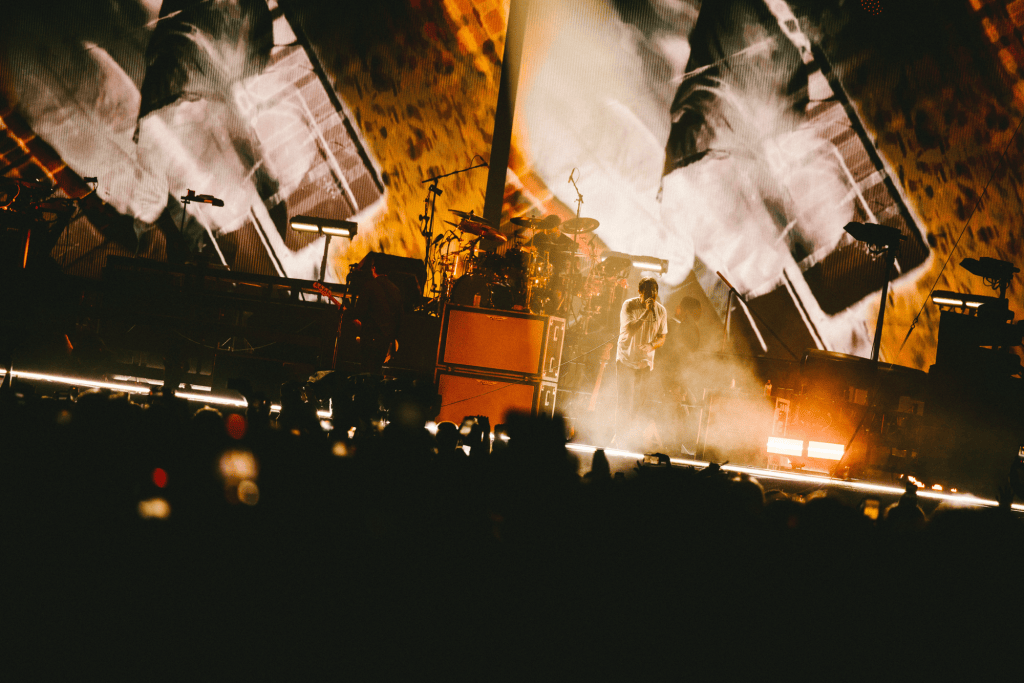
Then, at 8:45pm, the lights go down.
And suddenly I’m 15 again.
The opening bars of “Be Quiet and Drive (Far Away)”, from 1997’s Around the Fur, roll across the Royal Highland Centre.
Honestly: be still my beating heart.
There are songs you remember, and songs that remember you. “Be Quiet and Drive” belongs to the latter category. It is teenage escape disguised as a guitar song — the desire to get into a car, shut the door, put the music up and drive until your parents, your school, your town and your embarrassing adolescent self have all disappeared in the rear-view mirror. It sounds like headlights on an empty road and a bad decision that will probably turn out to be one of the better decisions you’ve ever made.
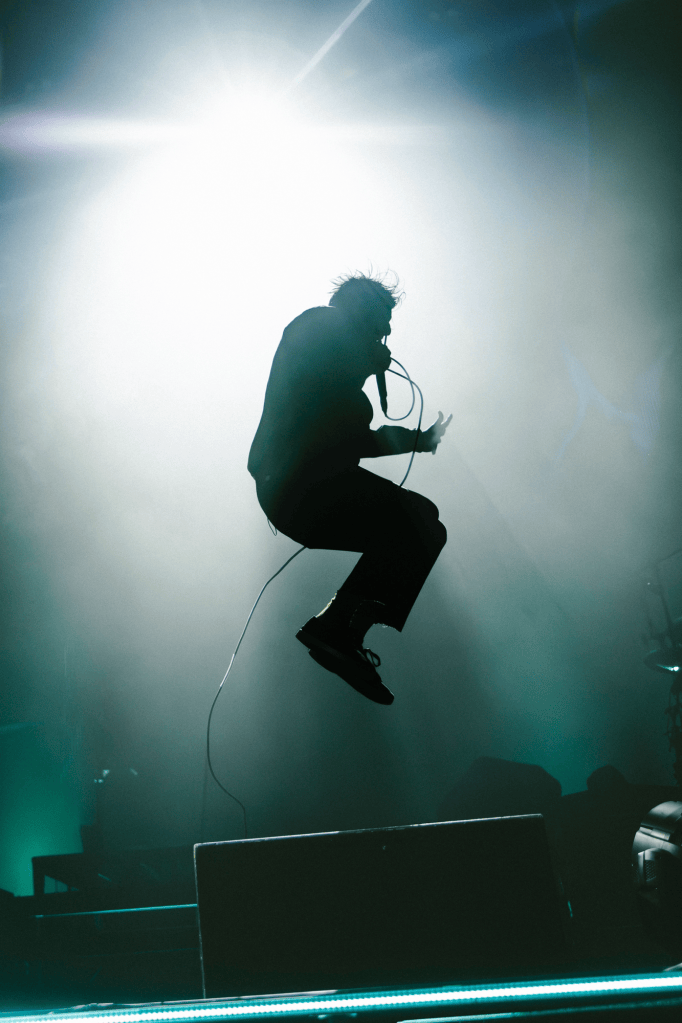
Chino Moreno is immediately everywhere, running from one end of the stage to the other, bounding up and down the platforms with the improbable grace of a ballerina who has been raised by wolves. He is a genuine showman, and there is something wonderful about watching him occupy the stage rather than merely stand on it. Behind him, the VJ visuals turn the enormous stage into a constantly mutating fever dream.
The rest of the band provide the architecture for this madness. Lance Jackman is the great slab of granite at the centre of the sound, his guitar turning riffs into geological events. Abe Cunningham is the engine room, bringing the muscular precision that stops all this atmosphere floating away into the ether. Frank Delgado is the ghost in the machine, supplying keyboards, samples and electronic textures that make Deftones sound less like a conventional metal band and more like a nightclub sinking slowly beneath the ocean. Fred Sablan, touring on bass, brings the subterranean weight that makes the whole thing physically register. And Chino, naturally, is the voice and the face: whisper, howl, seduction, menace and melancholy all sharing the same microphone.
Then comes “Cherry Waves”, from 2006’s Saturday Night Wrist, and suddenly the whole show becomes less like a rock concert and more like being swallowed by a very beautiful ocean. The song is sensual, melancholy and narcotic, Chino’s vocals drifting over the guitars like smoke under a locked bedroom door. This is the peculiar Deftones trick: they can make heaviness feel intimate. The guitars don’t simply crush you; they seduce you before doing it.
“Around the Fur”, from 1997’s Around the Fur, brings the brutality back. The title track sounds like adolescence with the safety catch removed. It is sweaty, ugly, thrilling and gloriously unrefined, a reminder of the period when Deftones could make a riff sound like somebody had just kicked through a bedroom wall. And yet even now it doesn’t feel like heritage rock. It feels alive. Most of us have aged. This song has apparently been drinking blood.
Then “Rosemary”, from 2012’s Koi No Yokan, stretches the evening out into something almost cosmic. This is where Deftones demonstrate that their real superpower isn’t heaviness but atmosphere. The song expands slowly, like a galaxy opening behind the stage, while Chino darts from platform to platform. His movement is extraordinary: part rock frontman, part ballet dancer, part man who has just remembered he left the oven on.
Then “Rocket Skates”, from 2010’s Diamond Eyes, hits like a car crash in expensive sunglasses. It is pure kinetic energy, Carpenter’s guitar providing the wreckage while Cunningham drives everything forward. If “Rosemary” is space, “Rocket Skates” is the asteroid hitting it.
And then comes “Sextape”, also from Diamond Eyes, and suddenly Deftones remind everyone why they have always been more interesting than the lazy nu-metal tag suggested. “Sextape” is erotic without being sleazy, intimate without becoming twee, and beautiful without losing its darkness. It sounds like perfume in a dark room. It is desire rendered as atmosphere rather than adolescent locker-room boasting. In the audience, people who now have mortgages, children and possibly a preferred brand of dishwasher tablet are singing along as though they’re 19 again. This is what Deftones do: they make respectable adults temporarily unavailable to themselves.
Then comes “milk of the madonna”, from 2025’s private music. This is important because tonight isn’t merely an exercise in nostalgia. Deftones have nine studio albums behind them, but private music demonstrates that they are not content to spend the rest of their career wearing the corpse of their younger self like a particularly fashionable coat. “milk of the madonna” sits comfortably among the older material — psychedelic, heavy, strange and sleek — proving that the band can still create music that feels like Deftones rather than music that sounds like a tribute to Deftones. The band’s own description of private music calls it both a psychedelic voyage and a skull-rattling wallop, which is annoyingly accurate.
Then they disappear.
The crowd waits.
And the encore begins with “Change (In the House of Flies)”, from 2000’s White Pony.
By now the sun is beginning to rise.
It is an almost indecently perfect visual metaphor. “Change” has always been about transformation, and here the night itself is transforming above us. The darkness slowly drains from the sky as the opening notes hang over the audience.
When I was 15, change was what I wanted.
Now, as a grown woman, change is something I occasionally regard as a personal attack.
But the song still works.
It is the sound of realising that the person you thought you would become isn’t necessarily the person standing here now — but that the teenager is still lurking somewhere underneath. Possibly demanding better lighting.
The tenderness lasts approximately four minutes before “Lotion”, from Around the Fur, arrives like a brick through a conservatory window. The song is the antithesis of middle-aged reflection. It is raw, confrontational and gloriously adolescent. If “Change” is the adult looking backwards, “Lotion” is the teenager shouting from the bedroom: “I DON’T WANT TO TALK ABOUT IT.”
And then, finally, “7 Words”, from 1995’s Adrenaline.
The beginning.
The primordial Deftones.
It sounds exactly as it should: furious, physical and slightly out of control. After three decades, it still has the energy of a teenager throwing their bedroom furniture through the window because their mother has asked them to turn the music down.
The crowd goes feral.
And that is the perfect ending.
Because Deftones haven’t simply soundtracked one generation’s adolescence. They’ve somehow preserved it.
The girl with the pink-and-green hair is still here. She’s just got older. She’s acquired responsibilities, and a wider world view and considerably less colourful hair. The eyebrow-pierced boy from the sixth-year common room is presumably somewhere with a mortgage and a LinkedIn account.
But play “Be Quiet and Drive” and we’re all back there.
The gym hall.
The school corridor.
The NME under the arm.
The impossible crush.
The conviction that nobody understands you.
The desperate desire to get away.
The strange belief that music might save you.
It probably can’t.
But on a night like this, it can certainly remind you that the person you were has never completely disappeared.
They’ve just been waiting for the right guitar riff.
And when that riff arrives, they are ready, they are dancing, they are chanting back every word – with a new generation looking in with adoration in their eyes.


Words: Angela Canavan
Images: Tim Craig

